
Deep Time

Earlier this week I was sitting in my car, gnashing my teeth while on hold with my bank dealing with one of life’s many administrative woes and compulsively clicking through emails when I happened to open a newsletter from High Country News linked to an article about deep time.
In the article, Emily Benson writes:
Winter is settling over the rolling hills of North Idaho, where I live. Snow ices the limbs of the bare aspens outside my window, while perfect flakes fall from the flat gray sky. This weather is my reality today, but it is also ephemeral; the blanket of snow will probably melt in a week or two. Three days ago, we were still awaiting the season’s first snowfall.
In fact, everything in my view is ephemeral. The largest aspen? Probably 15 years old. The window I’m looking through? Installed about 35 years ago. And beneath the snow, the hill my house sits on is made of loess, silt blown into the Palouse region from elsewhere periodically over the last 2 million years. That’s the blink of an eye in geologic time, though considerably longer than humanity has existed.
She goes on to explain the concept of deep time—geological time spanning billions of years, far beyond the range of human experience. She references John McPhee’s 1981 book Basin and Range, in which he illustrates humanity’s place on the geologic timescale by suggesting that you spread your arms out wide and imagine that the distance from fingertip to fingertip represents the age of the Earth—4.5 billion years. The 300,000 years since Homo sapiens evolved is so comparatively brief that, McPhee writes, “in a single stroke with a medium-grained nail file you could eradicate human history.”
White Sands
I visited White Sands National Park with friends over the New Year’s weekend, which brings up obvious correlations (sands of time, anyone?). It’s also home to a set of ancient human footprints thought to be the oldest evidence of humans in the Americas. And 250 million years before humans made their mark on this place, during the Permian period, it was covered by shallow seas.
Walking through the gypsum dunes, as silent and alien as the surface of the moon, it’s impossible not to feel the presence of deep time. We talked about how that weight of history made us feel—for my friend, it was deeply sad, and for me, it was soothing to think that in hundreds of thousands of years, there might be some other kind of beings walking through an unrecognizable landscape, looking at our footprints.
But the experience wasn’t as simple as being soothed by—or melancholy about—our relative insignificance compared with the vastness of time. For a species that could be obliterated by a single swipe of a cosmic nail file, humans have managed to wreak catastrophic devastation on our home planet. Which leaves me questioning—How can we understand our relationship with time in a way that makes us more conscious of the significance and impact of how we spend our days?
Slingshot
My sister got me a Slingshot planner for Christmas—created by the East Bay-based Slingshot Collective, it includes hand-drawn calendar spreads, information on effective protest strategies, tips to deal with cops and ICE, abortion resources, a menstrual calendar, and more. It also lists radical events for each day of the year (for instance, on this day in 1998, 25,000 people occupied the Narmada dam site in Western India, which was planned to submerge 61 villages, successfully delaying the completion of the dam wall for more than two decades; and in 2002, the U.S. military transported the first prisoners to Guantanamo Bay). Not only is it interesting to learn a bit of history every day, it also makes me think about the purpose of calendars, and how we use them.
What information does a typical calendar provide? It tells us what day of the week it is, and whether it’s a holiday. And basically what that tells us is whether we have to be at work or not. This reminds me of what Jenny Odell wrote about capitalism and different modes of attention in How to Do Nothing:
The cultivation of different forms of attention has a similar character [as a space capitalism cannot appropriate], since the true nature of attention is often hidden. What the attention economy takes for granted is the quality of attention, because like all modern capitalist systems, it imagines its currency as uniform and interchangeable.
Similarly, under capitalism, every day is an interchangeable unit of productivity—there’s no distinct meaning or flavor to individual days. But what if calendars told us something more?
Tonalpohualli
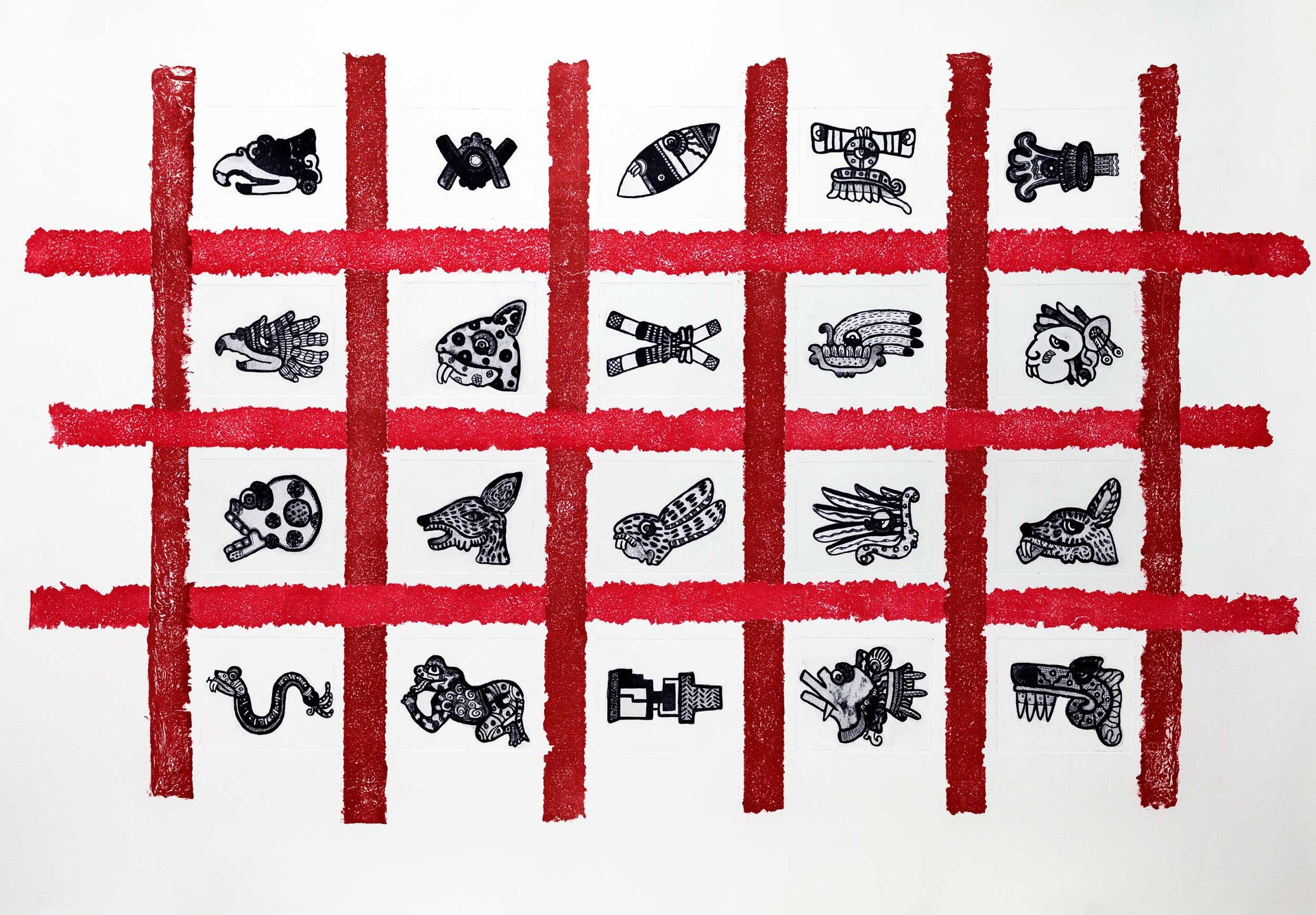
While I was researching an interview last month I happened across a lithograph by New Mexican Chicana artist Moira Garcia called Tonalpohualli. The title refers to one of the ancient calendar systems of Mesoamerica—in the Nahuatl language, Tonal is a word meaning day, sun, life essence, and spirit, and pohualli is the word for count and computation. “Therefore,” Garcia writes, “Tonalpohualli can be translated as the Count of Days or Suns as they relate to the spirit and soul of an individual.
The calendar is divinatory, composed from twenty recurring symbols known as day signs, each of which “has specific attributes and characteristics which mark the passing of time based on indigenous science and relationship to the cosmos,” Garcia writes. Her lithographs are representations of the Tonalpohualli as depicted in the Codex Borgia, a pre-colonial cosmological work originating in central Mexico, and incorporate subtle elements of hand-stitching that reference indigenous Mexican textile designs.
The day counts in this calendar were arranged in a rectangular grid meant to be read in a snaking pattern, beginning at the right of the bottom row and continuing upwards, first right to left, then left to right. The first glyph would be Cipactli, the crocodile, followed by Ehēcatl (wind), Calli (house), and Cuetzpalin (lizard), until all 20 days were counted, when the cycle would begin again with Cipactli.
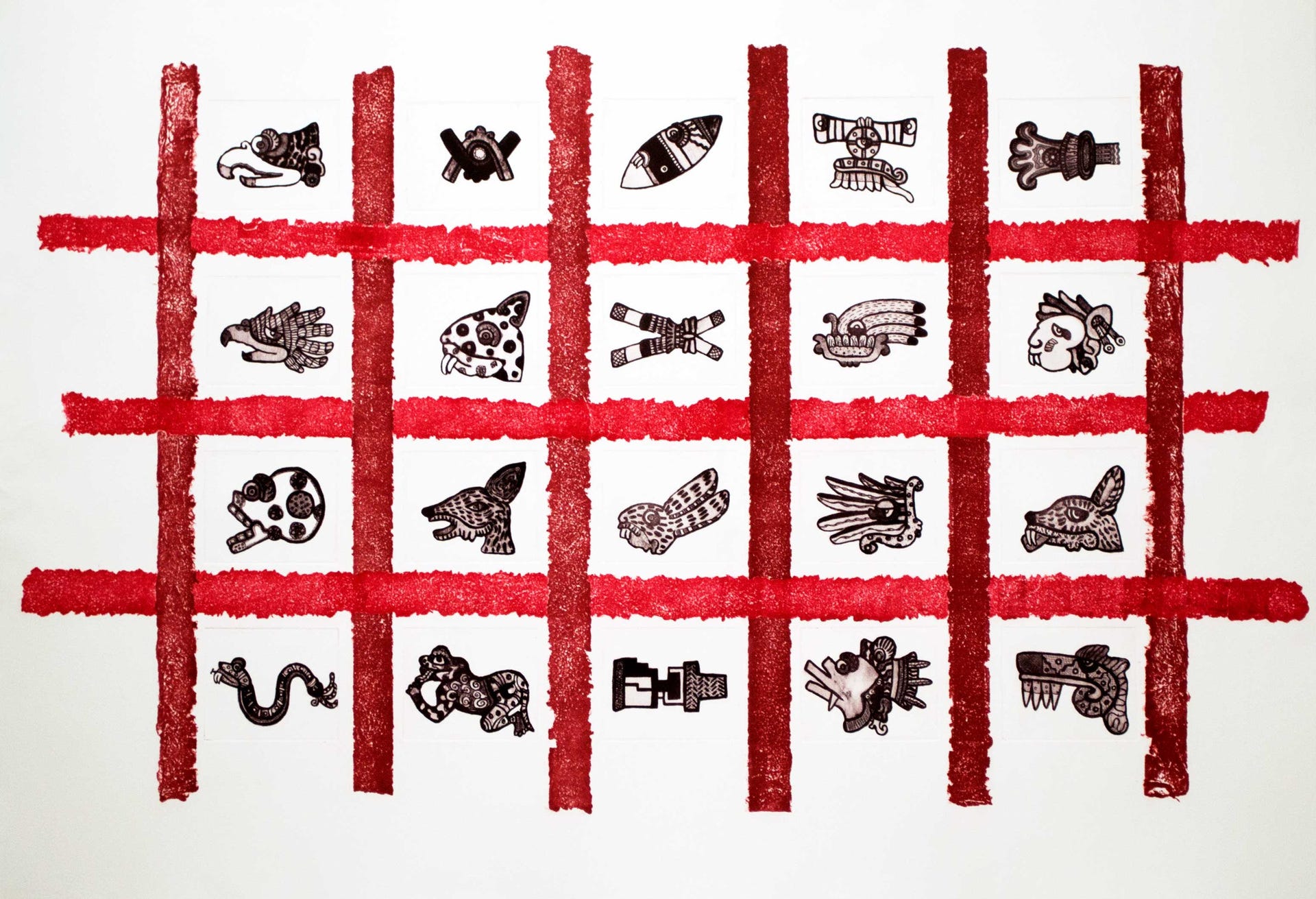
Garcia’s depiction of the first day in the cycle is the head of a crocodile in profile, accompanied by a chevron stitched in colored thread. In an article in Pasatiempo, Garcia is quoted explaining that in Mesoamerican cosmology, “The crocodile represents the first beginning, but it also has a relationship to water and earth,” and that the chevron “does represent water, but it can also represent earth, like a mountain design.”
The Tonalpohualli offered a lot more information than just whether you had to be at work or not. In Garcia’s words, it’s “a map for determining the destiny of a human being based upon the birthdate, as well as for calculating the cosmic energies and attributes of any period of time.”
Everywhere down the centuries
Susan Cooper wrote one of my all-time favorite series, the 1965-1977 The Dark is Rising Sequence about the epic struggle between light and dark. Cooper also wrote a poem about the winter solstice—the annual inflection point between dark and light—called The Shortest Day. It begins:
So the Shortest Day came
And the year died
And everywhere down the centuries of the snow‐white world
Came people singing, dancing,
To drive the dark away.
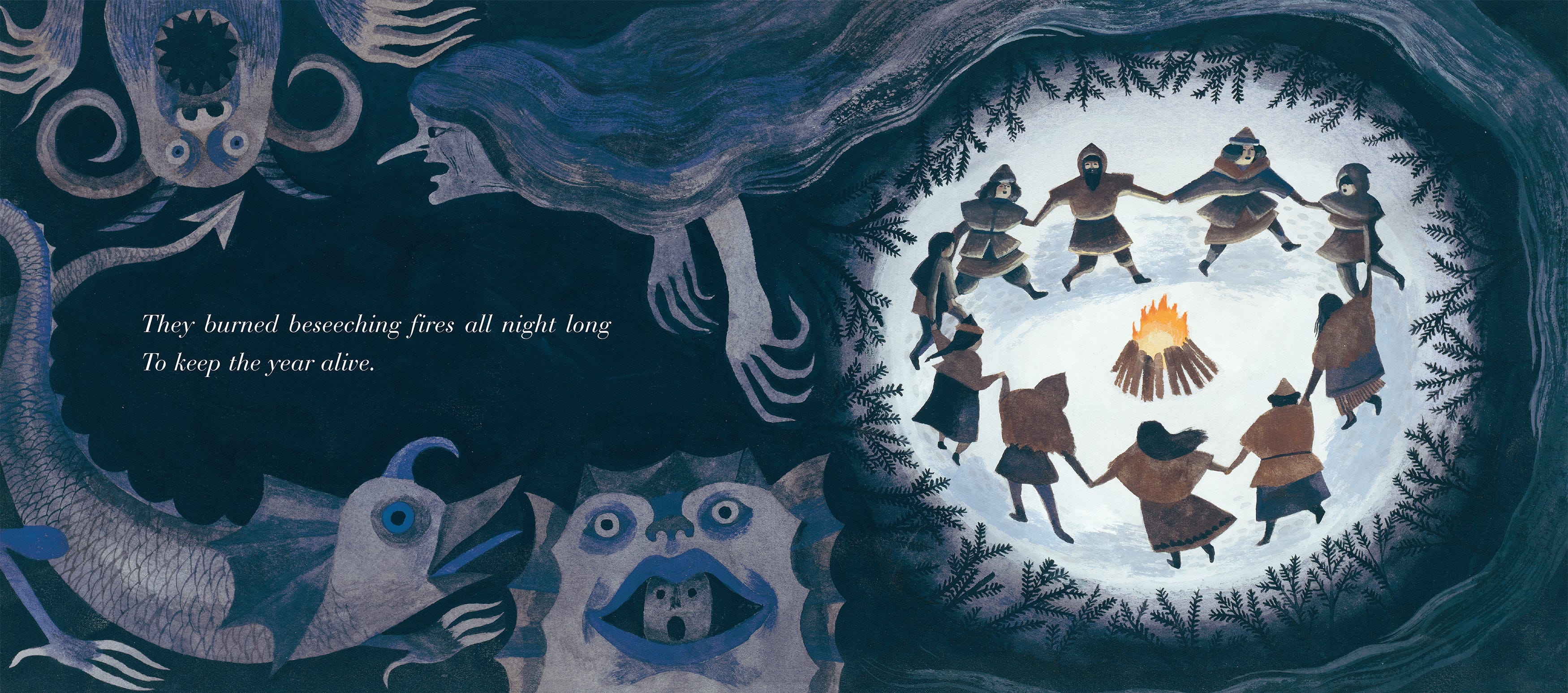
To me, Cooper has a unique ability to conjure the feeling of iterative recurrence. The phrase “Everywhere down the centuries,” carries with it a sense of the breadth of the experience it describes—everyone, all over the world, celebrating the turn of the year and the return of the sun—but also its depth through time.
What if each day carried the weight of all the recurrences of that day before it?
What if our calendars, like the Tonalpohualli and, in another way, my Slingshot planner, reminded us of those recurrences?
What if time is deep like that?